
What Am I Bringing to This Moment? De-Escalation Self Check for Professionals

A tense moment can turn quickly. A student refuses to leave the hallway. A parent raises their voice at dismissal. A client interrupts every sentence. A staff member steps in to help, but the room gets louder, faster, and more rigid.
In many escalating situations, the first instinct is to focus on the other person.
How do I get them to stop yelling?
How do I make them comply?
How do I regain control?
Those questions are understandable, especially when safety, learning, care, or team functioning is on the line. But one of the most useful de-escalation techniques starts with a different question:
What am I bringing to this moment?
That question does not blame the professional. It does not excuse unsafe or disrespectful behavior. It does not mean the other person’s choices are your responsibility.
It simply creates a pause before the next move.
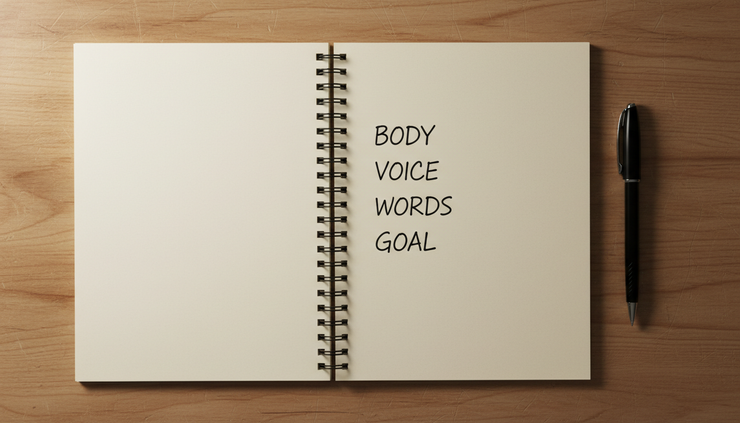
In that pause, professionals can notice whether their own body, voice, words, or goal are helping the situation stay workable, or unintentionally adding pressure.

Escalation often becomes reciprocal
Escalation can become reciprocal surprisingly quickly. In real interactions, people tend to respond to the energy in front of them.
Someone speaks faster, so the staff member speaks faster.
Someone interrupts, so the staff member interrupts back.
Someone raises their volume, so the adult raises theirs “just enough to be heard.”
Someone leans in, so the professional steps closer.
Someone becomes emotionally intense, so the responder becomes more urgent.
None of this has to be intentional. It can happen in seconds.
A professional may believe they are being firm, clear, or efficient. From the other person’s point of view, the same behavior may feel like pressure, challenge, or dismissal. That gap matters.
Reciprocal escalation is not about weakness or lack of skill. It is a normal risk in high-stress work. Schools, residential programs, community settings, behavioral support teams, and human-services environments all ask staff to make quick decisions while emotions are high and time feels short.
The danger is that professionals can lose choices without realizing it. The interaction starts to drive the response, instead of the response being chosen.
Self-regulation in de-escalation helps protect that choice point. It gives the professional enough space to ask, “What is actually needed right now?” rather than simply matching the pace or intensity of the moment.
This does not guarantee the other person will calm down. Some people will remain upset. Some situations will still require limits, support, removal of an audience, a safety plan, or crisis procedures. The value of self-regulation is that it helps the professional choose the next step with more care.
The goal is influence, not control
De-escalation is often misunderstood as a way to control another person’s behavior. That framing can lead to frustration. It can also lead professionals to push harder when the other person does not respond.
A better distinction is influence versus control.
Control means trying to force an internal state or immediate behavior change. Influence means arranging your own actions, words, distance, timing, and support in ways that reduce unnecessary friction and increase the chance of a safer outcome.
Influence still allows for firmness. It still allows for boundaries. It still allows for consequences, procedures, and calling for help.
Self-regulation does not mean:
accepting threats or harassment
ignoring safety concerns
staying physically close when distance is needed
allowing a person to disrupt others without response
trying to sound calm while having no plan
avoiding necessary limits
Sometimes the regulated response is a clear boundary. Sometimes it is a neutral question. Sometimes it is silence. Sometimes it is stepping back, switching staff, asking for additional support, or following established crisis prevention procedures.
The point is not to become soft. The point is to stay able to choose.
In a tense interaction, one of the professional's first tasks is to avoid adding unnecessary heat to the exchange. That begins with a self-check.

Four self-checks can change the next decision
The question “What am I bringing to this moment?” becomes more useful when it turns into something observable. Four areas are especially practical: body, voice, words, and goal.
Check your body
The body often speaks first.
Before a professional says anything, posture and proximity already send a message. Crossed arms, a squared stance, pointing, blocking an exit, hovering over a seated person, or moving in too quickly can raise tension.
These behaviors may come from urgency or habit. A teacher may step toward a student to keep the class moving. A supervisor may stand in a doorway to prevent someone from leaving. A staff member may lean forward because they are trying to hear. Still, the impact can be different from the intent.
A quick body check sounds like this:
Am I too close for this moment?
Am I facing the person in a way that feels confrontational?
Are my hands, shoulders, or facial expression adding pressure?
Am I blocking movement when I do not need to?
Is there a safer position that gives us both more space?
Helpful adjustments are usually simple. Angle the body slightly instead of standing squarely face-to-face. Create more distance when safe to do so. Keep hands visible and relaxed. Avoid sudden movements. Give the person room to breathe, think, or save face.
Body regulation is not about appearing passive. It is about not adding a physical challenge when the goal is to reduce unnecessary threat.
Check your voice
Voice can escalate even when the words are reasonable.
A professional may say, “I’m trying to help you,” but with a clipped tone, fast pace, or rising volume. The other person may respond more to the sound than the sentence.
Pace and volume matter because tense interactions already feel compressed. When the professional speeds up, the interaction can feel more urgent. When the professional gets louder, the other person may get louder to match or resist. When the professional speaks over the person, the exchange can become a contest.
A useful voice check includes:
Am I speaking faster than I need to?
Am I raising my voice to match theirs?
Am I talking over them?
Is my tone sharper than the situation requires?
Could a shorter sentence, slower pace, or lower volume help me think better?
Lowering volume does not mean whispering. It means choosing a volume that fits the setting and the safety need. Slowing down does not mean dragging out the situation. It often makes directions easier to process and gives the professional more time to decide what should happen next.
Voice regulation protects clarity.
Check your words
In tense moments, more words are not always more helpful.
Professionals often explain, correct, remind, warn, persuade, and justify all at once. The intention may be good. The result may be overload.
A student who is already upset may not need a full explanation of the rule. A parent who feels dismissed may not be ready for a policy review. A client who is pacing may not benefit from repeated questions. A staff member in conflict may not need a lecture in the hallway.
Unnecessary words can add fuel when they:
repeat what the person already heard
argue about details that can wait
correct tone instead of addressing the immediate need
demand insight in the middle of distress
stack multiple directions into one speech
include sarcasm, moralizing, or “you always” language
A words check sounds like this:
What is the minimum helpful sentence right now?
Am I explaining to help, or explaining because I feel challenged?
Does this need to be said now?
Am I asking a question I actually want answered?
Am I using words that invite cooperation or words that corner the person?
Short, concrete language often works better than long explanations. For example:
“Step over here with me.”
“I can listen when we’re not shouting.”
“You can take a minute, and I’ll stand right here.”
“I’m going to call another staff member so we can slow this down.”
“That language is not okay. We can continue when it stops.”
The best words depend on the situation. The self-check helps remove the extras that are more about the professional’s frustration than the immediate need.

Check your goal
The goal may be the most important self-check.
In escalating situations, the stated goal and the actual goal can drift apart. A professional may believe the goal is safety, learning, or support. Under stress, the goal may quietly become winning the exchange, proving a point, getting the last word, or forcing immediate compliance.
That shift can happen to skilled people. It often shows up in phrases like:
“I’m not letting them talk to me like that.”
“They need to understand why this is unacceptable.”
“They’re going to do it because I said so.”
“I already told them three times.”
“I can’t let them think they got away with it.”
Some of those concerns may be valid. Respect matters. Accountability matters. Clear expectations matter. But timing matters too.
A goal check asks:
What outcome is most important in the next two minutes?
Is the priority safety, dignity, movement, information, privacy, or a limit?
Am I trying to solve the whole problem right now?
Am I responding to the behavior, or to feeling disrespected?
Would my current approach still make sense if someone reviewed it later?
A clear goal reduces unnecessary struggle.
For example, if the immediate goal is to move a student away from an audience, the professional may not need to address every disrespectful comment in the moment. If the goal is to assess safety, a calm question may matter more than a rule reminder. If the goal is to stop harm, a firm directive and additional support may be more appropriate than continued conversation.
The goal should guide the intervention, not the other way around.
Regulation comes before intervention in the PRIME framework
Open Hands’ PRIME framework places Regulation before Intervention for a practical reason. A professional who is regulated has more access to options.
That does not mean the professional feels calm, comfortable, or unaffected. Regulation is not a personality trait. It is a set of moment-to-moment choices that help staff avoid being pulled into automatic reactions.
When Regulation comes first, Intervention becomes more deliberate.
The professional can ask:
Is this a teaching moment, a safety moment, or a support moment?
Should I set a boundary, ask a question, reduce language, create space, or call for help?
Is my presence helping, or would another person be more effective?
Do we need to disengage and follow a documented plan?
What does policy, training, and the person’s support plan require?
This sequence matters because intervention without regulation can become impulsive. A staff member may over-talk, crowd, threaten consequences too soon, or personalize the behavior. A supervisor may step in with authority but miss the need to lower the room’s intensity. A team may unintentionally surround a person when one calm responder would be better.
Regulation helps professionals choose the least escalatory effective response available. Sometimes that response is gentle. Sometimes it is firm. Sometimes it is procedural. The key is that it is chosen, not simply triggered.
The pause that protects better choices
The question “What am I bringing to this moment?” is not a script. It is a discipline.
It helps a professional notice the part of the interaction they can influence most directly: their own posture, distance, pace, volume, language, and purpose. That focus is not self-blame. It is professional responsibility.
The other person may still be angry. They may still refuse. They may still need a clear limit, more support, or a safety response. Self-regulation does not promise a calm ending.
What it does offer is a better chance of avoiding unnecessary escalation. It keeps the professional from matching every interruption, every sharp tone, every demand, and every surge of intensity. It creates enough room to decide what the moment actually calls for.
Before the next intervention, direction, correction, or consequence, pause long enough to ask the question that can change the path of the interaction:
What am I bringing to this moment?
For training and support that builds these skills into daily practice, explore Open Hands’ services for de-escalation and crisis prevention.

Hi Robbie, I really liked what I read. I can see the professional responding to the pre-intervention techniques once they have learned those skills. Question: Why did you introduce “save face” ?
Robert, I like this framework very much. One of my mentors, LaSalle Leffall, taught his surgical trainees “equanimity under duress” — originally for surgical emergencies, but it applied just as much once I moved into administrative roles, facing supervisors, patients, and adversarial media. I did not always maintain it myself; the limbic system takes over when you feel challenged or falsely accused. Your body/voice/words/goal self-check gives that instinct something concrete to hold onto.
Training with real-world challenges and simulation of high-risk conversations will be key to making this resonate. Litigators and politicians earn that composure through repeated on-the-job practice; most professionals never get it. Well done, and I wish you continued success with this work.