
Your Classroom Rules Aren’t Cutting It

Rules matter. But strong classroom culture requires much more than telling students what they can and cannot do.

If today was your first day, or your students are arriving sometime this week, this is when the rules start meeting reality.
Okay, you can lower your pitchforks. I'm not saying classroom rules don't matter.
They do.
Students need boundaries. Teachers need clarity. Schools need shared expectations.
Accountability matters.
But rules cannot do all of the work by themselves.
A rule will tell students where you draw the line. It will not teach them how to disagree respectfully, ask for help, handle frustration, work collaboratively with others, heal harm, or contribute to the kind of classroom community we want them to experience.
That's the difference.
Rules set the boundaries. Culture is built in what happens inside them.
Not All Classroom Structures Do the Same Job
One reason classroom culture can become confusing is that we sometimes ask one tool to do the job of another.
Think about them this way:
Rules establish necessary boundaries.
Expectations name broader standards or values such as respect, responsibility, safety, or belonging.
Norms give those values shared meaning within a particular community.
Routines turn them into things students can actually do repeatedly.
PBIS emphasizes this progression from defining expectations to explicitly teaching the social, emotional, and behavioral skills students need across settings. Classroom practices should also align with the school's larger framework rather than forcing students to decode an entirely different system in every room.
So, posting Respect is a start.
But students still need to understand:
What does respect look like when we disagree?
That's where culture begins moving from something we announce to something students can actually experience.
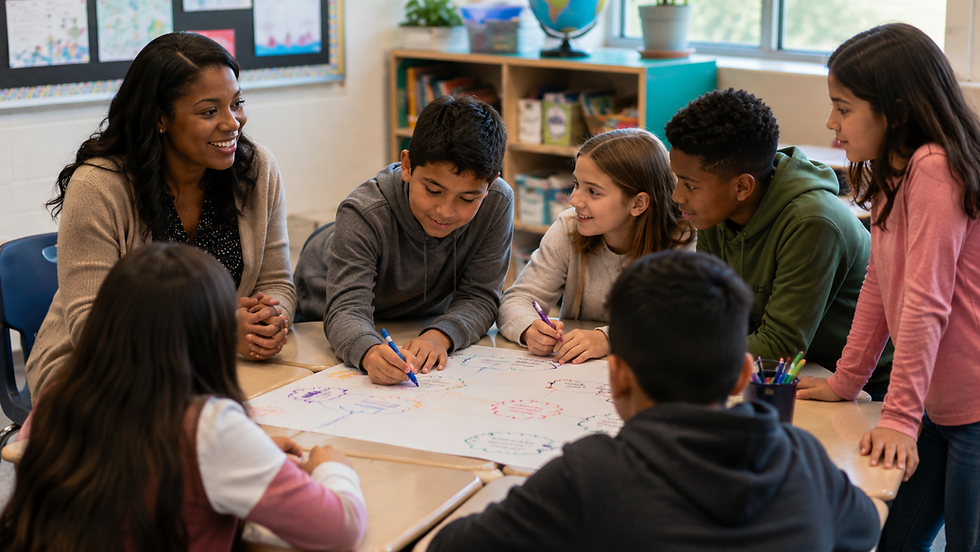
Build the Norms WITH Them
Adult leadership is still essential.
Safety requirements, district policy, necessary academic expectations, and another student's right to learn are not simply up for a classroom vote.
But students should have meaningful influence over how the community will live successfully within those boundaries.
Ask:
What helps us learn here?
What gets in the way?
What should disagreement look like?
What should happen when someone makes a mistake?
What should students and adults be able to expect from one another?
The process should mature with the student.
Younger students may need concrete examples, modeling, pictures, or role-play. Adolescents should increasingly receive meaningful rationale, voice, and influence where genuine choice exists. High-school PBIS specifically emphasizes student input as an important part of implementation.
Then turn the conversation into a shared agreement.
When appropriate, students and adults can sign or affirm it. With the youngest students, that signature might even be a messy, painted handprint, but you get the idea.
But the agreement should never become:
"You signed this, so I caught you!"
Instead:
"This is what we said we needed from one another. How are we doing?"
Adults belong in that agreement too. If students are expected to listen, acknowledge mistakes, and treat people respectfully, they should reasonably expect adults to model those commitments.
That's shared accountability.
If It Matters Enough to Correct, It Matters Enough to Teach
This is where classroom rules often reach their limit.
We explain an expectation.
Students do something different.
We correct it.
And sometimes correction is entirely appropriate. Students can understand an expectation and still make a poor choice.
But when we're correcting the same thing repeatedly, it is worth asking another question:
Have we actually taught students how to meet this expectation for this setting?
For example, let's say the expectation is Responsibility.
During independent work, that might mean beginning on time, having materials ready, knowing how to request help, using technology appropriately, and getting back on track after becoming distracted.
Now we have moved from an abstract value toward something students can practice.
Think of it as:
Expectation → Norm → Routine → Practice
Then build practice into real school experiences.
Teach the entry routine during entry.
Practice collaboration during actual group work.
Model respectful disagreement during real discussion.
Provide feedback while students are actually using the skill.
Over time:
Teach → Model → Practice → Feedback → Repeat → Greater Independence
Different students, skills, and settings will require different amounts of practice.
And the delivery should mature with students. Adolescents do not need to be treated like elementary students simply because we are explicitly teaching a routine.
Explicit does not have to mean elementary.

Relationships Give Accountability Somewhere to Stand
Rules describe expectations.
Relationships shape how students experience the adults responsible for upholding them.
That doesn't mean delaying academics while we spend weeks on relationship-building activities.
Connect while you teach. Teach while you connect.
Learn names.
Acknowledge effort.
Remember something a student shared.
Listen before assuming.
Correct without humiliating.
Follow through.
Students do not need educators to become their best friends. They do need consistent evidence that the adults responsible for guiding, supporting, and sometimes correcting them are genuinely invested in their success.
That matters when the difficult moments eventually arrive.
Don't Wait for Dysregulation to Teach Regulation
A rule might tell students to keep their hands to themselves, use appropriate language, or remain in the learning environment.
But rules alone do not teach regulation.
If students have access to a reset process, movement break, check-in, trusted adult, Calm Corner, or another regulation support, the hardest moment should not be the first time we explain how to use it.
Teach regulation supports while students are regulated.
Students should understand what support exists, how they might recognize that they need it, how to access it appropriately, and how to return afterward.
But not every challenging behavior is dysregulation, and regulation does not remove accountability. Sometimes regulation is simply what allows meaningful correction, problem-solving, reflection, or repair to take place.

The Opening Weeks Are for Building, Not Just Enforcing
The first several weeks of school give us an unusually useful opportunity.
Not because culture must be perfected by a particular date.
It won't be.
But early in the year, we can invest more heavily in building relationships, clarifying norms, modeling routines, practicing expectations, giving feedback, and adjusting before patterns become harder to change.
Restorative practice offers a useful parallel. IIRP recommends an 80/20 emphasis, with most restorative effort happening proactively to strengthen relationships and build community before harm occurs.
The idea is simple:
Do more of the relationship and community work before you need the repair work.
That doesn't eliminate rules, consequences, or accountability.
It gives them a stronger foundation.
Keep Adjusting
Even a strong first week will teach us something we didn't know when we planned it.
Maybe a routine doesn't work with this particular group.
Maybe students need more practice.
Maybe an individual student needs something beyond universal support.
That's information.
So, keep asking:
What is working?
What keeps breaking down?
What needs to be taught again?
What are students telling us?
What might adults need to change?
Then continue:
Connect → Co-create → Teach → Practice → Reinforce → Reflect → Adjust
Your classroom rules aren't the problem.
Expecting the rules to build the culture for us is.
Rules establish necessary boundaries.
But relationships, shared ownership, explicit teaching, routines, practice, regulation, reinforcement, reflection, and accountability help turn those boundaries into a functioning community.
Eventually, the goal becomes less:
"Those are the teacher's rules."
and more:
"This is how we agreed to learn and live together here."
And ideally:
"This is something we built together."

Comments